
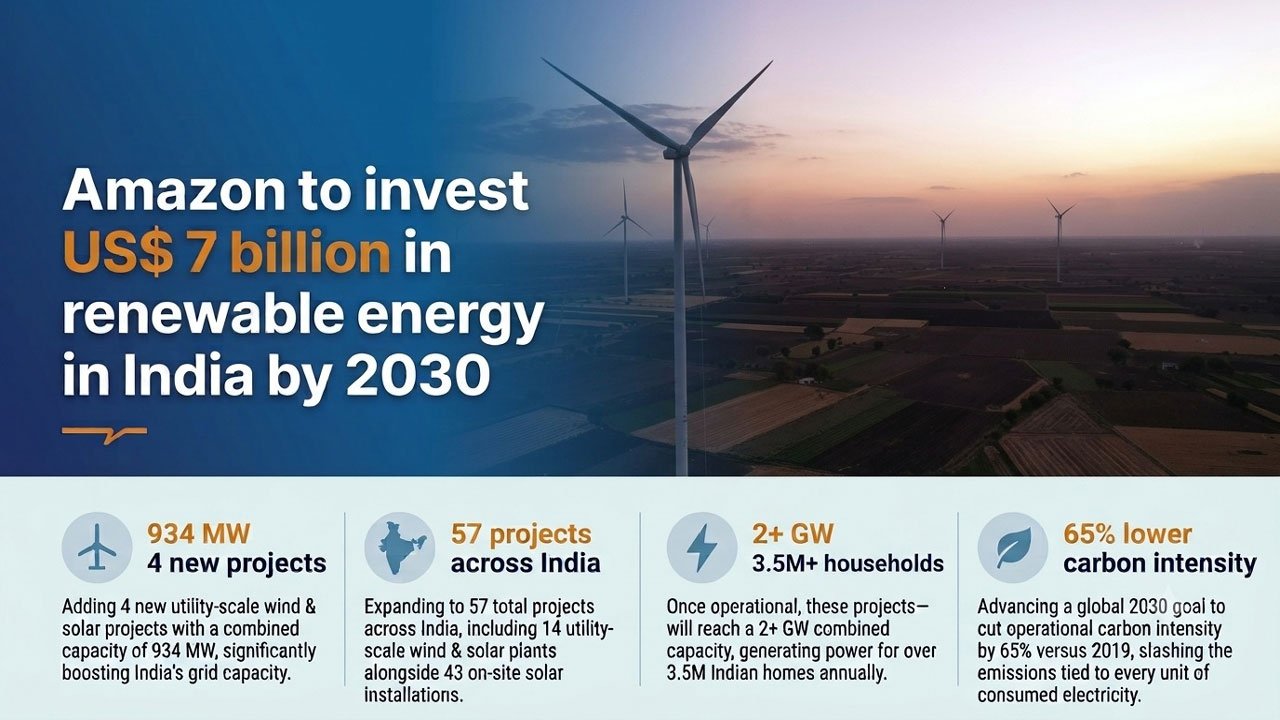
Amazon has announced a commitment to invest USD 7 billion in renewable energy projects in India by 2030, significantly expanding its green energy initiatives. This investment follows an earlier commitment of USD 4 billion and aims to enhance the company’s renewable energy portfolio in the country.
Details of the Renewable Energy Projects in India
The new investment will support four large-scale wind and solar projects with a total capacity of 934 megawatts (MW). These projects include a 234 MW wind farm and a 200 MW hybrid solar-wind project in Karnataka, a 300 MW solar project in Madhya Pradesh, and a 200 MW solar initiative in Rajasthan. All projects are secured through Power Purchase Agreements (PPAs), which will bring Amazon’s total renewable capacity in India to over 2 gigawatts (GW), capable of powering more than 3.5 million households annually.
Impact on Carbon Reduction and Economic Growth
Amazon’s investment aligns with its global target to reduce the carbon intensity of its electricity usage by 65 percent by 2030, based on a 2019 baseline. This effort is part of Amazon’s broader Climate Pledge to achieve net-zero carbon emissions by 2040. Union Minister Shri Pralhad Joshi welcomed the announcement, stating that such investments bolster India’s clean energy ambitions and contribute to economic growth. Kara Hurst, Amazon’s Chief Sustainability Officer, emphasized the company’s commitment to supporting India’s rising electricity demand and its goal of achieving net-zero emissions by 2070.
Amazon’s Broader Sustainability Initiatives in India
In addition to these renewable energy projects, Amazon’s sustainability efforts in India include deploying over 15,000 electric vehicles across more than 500 cities and achieving water-positive status ahead of schedule. The company has invested over ₹62 crore in water replenishment projects, returning more than 120 percent of the water used in its operations. Furthermore, over 50 percent of customer orders in India are now shipped using reduced or original packaging, with collaborations to develop eco-friendly alternatives from agricultural residue.
The next steps for Amazon include the continued development of these renewable projects, which are expected to modernize India’s energy infrastructure and enhance job creation and grid reliability.