
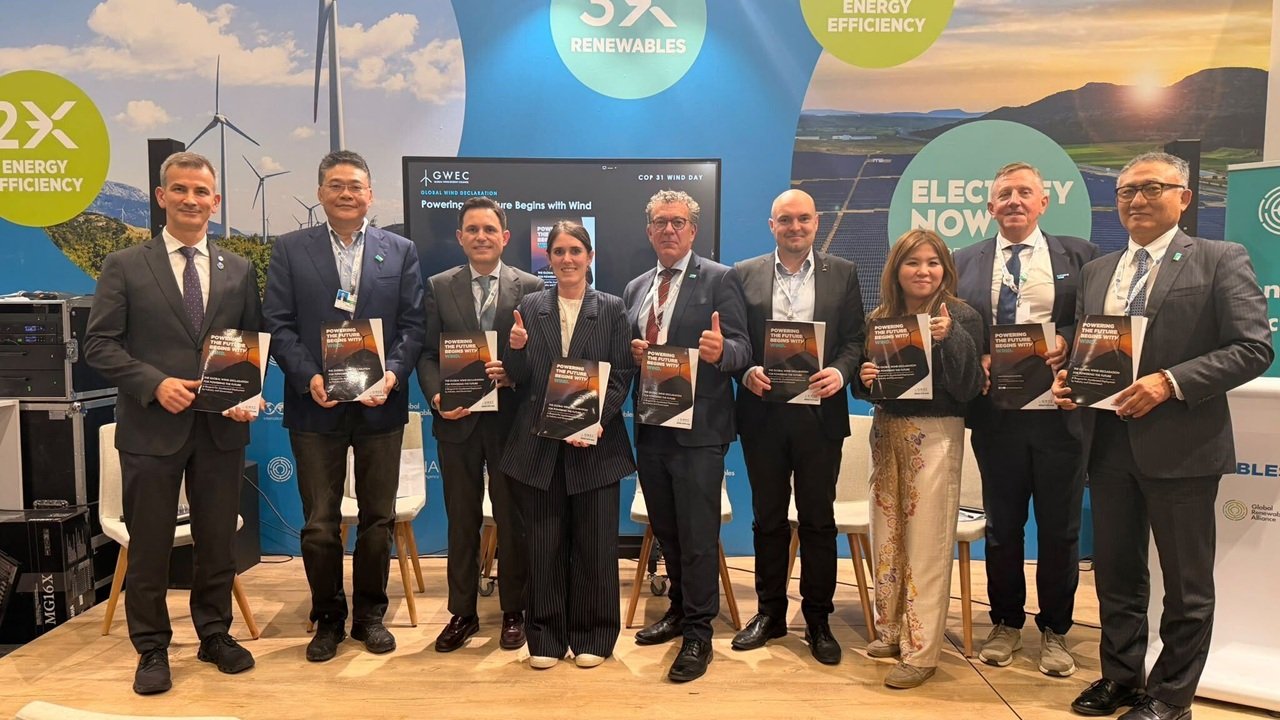
The global wind energy sector has unveiled a roadmap at COP31 in Turkey aimed at accelerating project development and reaching a target of 4 terawatts (TW) of capacity by 2035. This initiative, known as the Global Wind Energy Declaration to Power the Future, is a collaboration between the Global Wind Energy Council (GWEC) and the Turkish Wind Energy Association (TÜREB). It combines private sector commitments with government recommendations to enhance investment conditions in the renewable energy landscape.
Global Wind Capacity Growth and Challenges
The declaration highlights the need to overcome barriers that hinder the rapid development of new wind farms, particularly concerning permits, infrastructure, financing, and supply chains. Ben Backwell, CEO of GWEC, emphasized the urgency of streamlining the permitting process, stating, “If, for example, it takes two years to build an offshore wind farm, it shouldn’t take eight to twelve years to obtain the necessary permits.”
Data from GWEC indicates that global wind power capacity reached 1,299 gigawatts (GW) by the end of 2025, having increased more than twentyfold in the last twenty years. In 2025 alone, 165 GW of new capacity was added, which is 40 percent more than the previous year, enough to power an additional 118 million homes. The roadmap anticipates that with enhanced public support and investment, wind power capacity could potentially exceed 4 TW by 2035.
Principles for Accelerating Wind Energy Implementation
The wind declaration outlines five key principles to expedite the implementation of wind energy projects. These principles include ensuring regulatory certainty, fostering regional wind industries, promoting innovation, improving energy system integration, and maximizing offshore wind potential. Michael Hannibal, president of GWEC, noted the industry’s current capacity and the necessity to mobilize sufficient investment to surpass the 4 TW target.
İbrahim Erden, president of TÜREB, highlighted that achieving these advancements will require a combination of predictable policies, efficient permitting processes, timely investments in infrastructure, and access to competitive financing. The declaration also emphasizes the importance of developing offshore wind energy to meet future demands.
Rafael Munilla, business development director at Ocean Winds, stated that while the sector is prepared to invest, it requires “visibility and confidence” to convert potential projects into actual capacity. The declaration links the acceleration of renewable energy deployment with the rising demand for electricity, driven by advancements in artificial intelligence and data centers, which intensify pressure on energy infrastructure.
GWEC advocates for a shift from isolated project planning to integrated strategies that encompass generation, storage, and grid development. Kane Xu, senior vice president of Envision Energy, remarked that the future growth of wind power will rely not only on improved turbine technology but also on the integration of wind energy with battery storage, smart grids, solar energy, and green hydrogen.